Göbekli Tepe: What Was Really Found and What Visiting Is Like Today
Göbekli Tepe, located in south-eastern Türkiye near the city of Şanlıurfa, has reshaped how archaeologists understand the beginnings of organised religion and monumental architecture. Often dated to around 9600–8200 BCE, the site predates Stonehenge by several millennia and the Egyptian pyramids by far longer. What was uncovered here is not a lost city in the classical sense, but a complex of circular and oval enclosures built by hunter-gatherers at the end of the last Ice Age. Today, it stands as one of the most important archaeological destinations in the world, protected as a UNESCO World Heritage Site and carefully prepared for visitors who want to see the origins of monumental ritual spaces with their own eyes.
What Archaeologists Actually Discovered at Göbekli Tepe
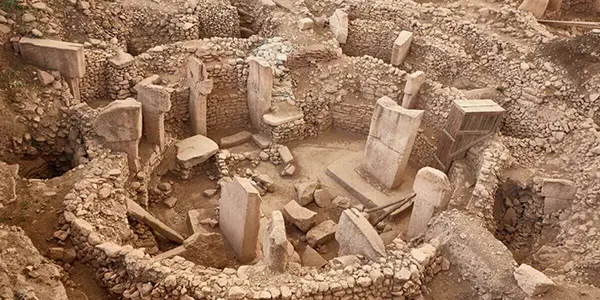
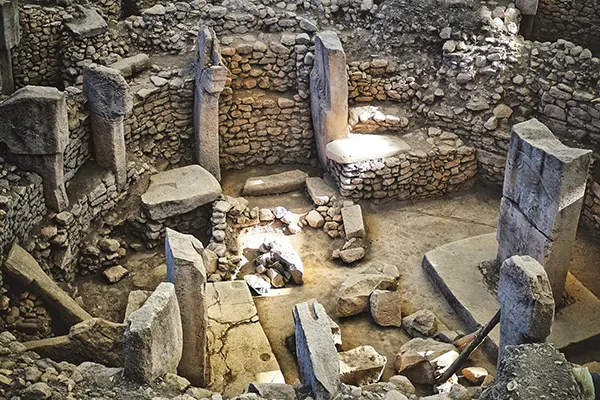
The first systematic excavations began in 1995 under the direction of German archaeologist Klaus Schmidt, although the mound itself had been noted in the 1960s. What emerged from beneath the soil were massive T-shaped limestone pillars arranged in circular structures. Some of these pillars reach over five metres in height and weigh up to 15–20 tonnes. Radiocarbon dating confirmed that the earliest layers belong to the Pre-Pottery Neolithic A period, making the site more than 11,000 years old.
The pillars are not plain. Many are decorated with finely carved reliefs of animals including foxes, wild boars, snakes, cranes, vultures and aurochs. In some cases, stylised human arms and hands appear on the sides of the central monoliths, suggesting that the pillars themselves represent anthropomorphic beings. There is no evidence of domestic structures such as houses, hearths or everyday tools in the earliest layers, which has led most researchers to interpret the complex as a ritual or ceremonial centre rather than a settlement.
Perhaps the most surprising finding is that the entire complex was deliberately buried around 8000 BCE. The enclosures were filled with rubble, bones and debris, effectively sealing them. This act of intentional backfilling preserved the carvings in remarkable condition. It also indicates that the people who built Göbekli Tepe made a conscious decision to end its use in a structured way, rather than abandoning it through collapse or natural disaster.
Why Göbekli Tepe Changed Our Understanding of Prehistory
Before Göbekli Tepe was excavated, the prevailing theory held that agriculture came first, followed by permanent settlements and, only later, monumental religious structures. The site challenges this sequence. The builders were still hunter-gatherers, yet they organised large labour forces to quarry, transport and erect enormous stone pillars. This suggests that complex social and symbolic systems may have developed before fully established farming communities.
The scale of coordination required is significant. Moving stones weighing several tonnes without metal tools or wheeled transport implies careful planning and strong communal motivation. Some scholars argue that shared ritual practices may have brought scattered groups together seasonally, reinforcing social bonds and possibly even encouraging the later transition to agriculture in the surrounding region.
In addition, the artistic sophistication of the carvings demonstrates advanced symbolic thinking. The animals depicted are often dangerous or powerful species, which may have held mythological meaning. Although no written records exist from this era, Göbekli Tepe provides rare physical evidence of early belief systems and organised ceremonial behaviour at the dawn of the Neolithic period.
How the Site Looks Today in 2026
Since being inscribed as a UNESCO World Heritage Site in 2018, Göbekli Tepe has undergone significant conservation work. A large protective roof now covers the main excavation area, shielding the exposed pillars from sun, wind and seasonal rainfall. Elevated walkways allow visitors to move around the enclosures without stepping directly onto the archaeological layers, reducing erosion and preserving the fragile remains.
In 2026, the site remains an active research location. Only a small percentage of the mound has been excavated, and geophysical surveys suggest that many more enclosures remain underground. Visitors can see several of the most prominent circular structures, often labelled as Enclosures A, B, C and D. Information panels in Turkish and English provide context about the chronology, the carvings and the excavation process.
The atmosphere is strikingly different from visiting later historical monuments. There are no towering city walls or elaborate temples. Instead, the experience centres on viewing the exposed stone circles beneath the protective canopy, with the surrounding Mesopotamian plains stretching into the distance. The setting reinforces the sense that this was once a remote hilltop gathering place rather than an urban centre.
Practical Information for Visitors
Göbekli Tepe is located approximately 15 kilometres north-east of Şanlıurfa. The nearest major airport is Şanlıurfa GAP Airport, with domestic connections to Istanbul and Ankara. From the city centre, taxis, organised tours and rental cars are the most convenient ways to reach the site. The road infrastructure has improved in recent years, making access straightforward.
The site is generally open year-round, although opening hours vary by season. Summers in south-eastern Türkiye can be extremely hot, with temperatures frequently exceeding 40°C. Visiting in spring or autumn is often more comfortable. The protective roof provides shade, but visitors should still bring water, sun protection and appropriate footwear, as the terrain around the walkways is uneven.
A small visitor centre near the entrance offers ticketing facilities, restrooms and basic exhibition displays explaining the history of the excavations. Many travellers combine a visit to Göbekli Tepe with the Şanlıurfa Archaeology Museum, which houses artefacts from the region and provides broader context for Neolithic life. Together, these locations create a more complete understanding of the cultural landscape in which the site emerged.
Common Myths and What the Evidence Actually Shows
Göbekli Tepe has attracted numerous speculative theories, ranging from lost advanced civilisations to extraterrestrial involvement. While such claims often circulate online, they are not supported by archaeological evidence. The construction techniques, tools and material culture discovered at the site are consistent with what is known about late hunter-gatherer societies in the region.
Another frequent misconception is that Göbekli Tepe represents the world’s first temple in a strict religious sense. While it is one of the earliest known large-scale ritual complexes, the term “temple” carries assumptions derived from much later organised religions. Scholars generally describe it more cautiously as a ceremonial or ritual centre, reflecting the limited information available about belief systems at that time.
Finally, some assume that the entire site has already been revealed. In reality, only a fraction of the mound has been excavated as of 2026. Ongoing research, including ground-penetrating radar and careful stratigraphic excavation, continues to refine our understanding. The significance of Göbekli Tepe lies not in sensational claims, but in the solid, measurable evidence that complex symbolic architecture emerged far earlier than once believed.
Why Göbekli Tepe Remains So Important Today
For historians and archaeologists, Göbekli Tepe represents a turning point in the study of human societies. It forces researchers to reconsider how social organisation, ritual practice and large-scale cooperation developed at the end of the Ice Age. The site demonstrates that monumental building was not exclusively tied to settled agricultural states.
For travellers, the experience is quieter and more reflective than visiting later, more elaborate ruins. Standing beside pillars carved over eleven millennia ago creates a tangible connection with people whose names and languages are lost, yet whose artistic and organisational skills are unmistakable. It is not a spectacle of grandeur, but a place that prompts questions about how early communities understood their world.
In 2026, Göbekli Tepe remains both a carefully managed heritage site and an active field of scientific study. Its global importance lies in the clarity of the archaeological record and the questions it continues to raise. Anyone interested in the origins of civilisation will find here not fantasy, but evidence—carefully unearthed, documented and still being explored.